
AI Is Impacting How Content Gets Noticed. What Can You Do About It
/
By Lisa Van de Ven
SEO. AEO. GEO.
If you work in marketing or content creation, you’re likely seeing these acronyms a lot. But what do they mean for your business?
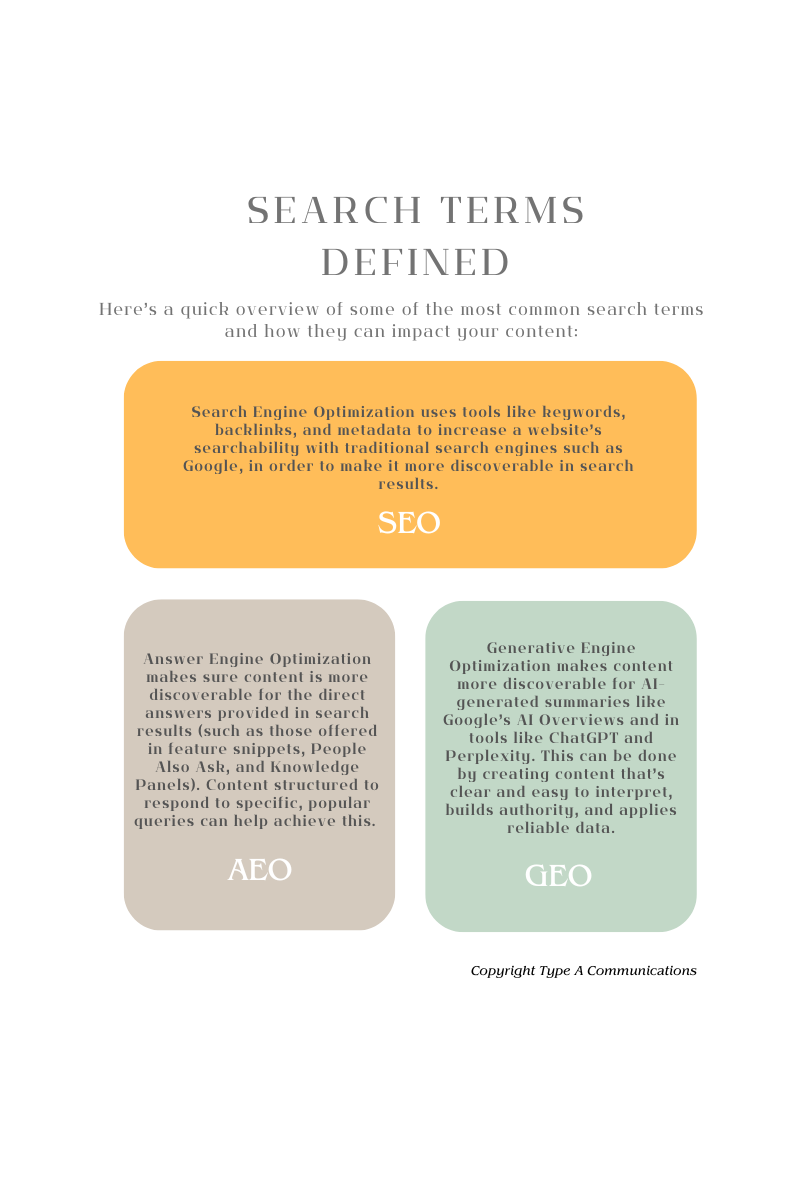
Search Engine Optimization (SEO), Answer Engine Optimization (AEO), and Generative Engine Optimization (GEO) together represent the new search battleground content creators are trying to conquer.
SEO, of course, has long been a focus for content teams, but AEO and GEO add a whole new dimension—one in which AI plays a key role. And for most businesses today, ignoring the impact of AI on your content visibility is a good way to stay invisible.
So where do you start optimizing your content strategy for AI? Let’s dig into some answers.
The Impact of AI on Search
The way that people find your content is changing. Today, results from tools like Google’s AI Overviews show up even before standard search results, pulling on content from across the Internet—often with the exact answers people are looking for summarized in easy-to-digest nuggets.
Not surprisingly, then, with all of that information already outlined for them, people don’t always have a reason to click on your site to find the answers they need, the way that they used to. Website views everywhere have been impacted as a result.
How much of an impact does this actually represent? Consider an experiment by Ahrefs. They analyzed 300,000 keywords, finding that the presence of an AI Overview in the search result correlated with a 34.5% lower average click-through rate for the top-ranking pages, when compared to similar keywords without an AI Overview.
According to data from Pew Research, when faced with an AI summary:
Only 1% of Google users are likely to click on a link within the AI summary
26% will end their browsing session completely, clicking nowhere
Only 8% will click on a link from the search results below the AI summary
This data demonstrates the impact of AI Overviews, and the importance today of optimizing for AI search through GEO. Features like snippets, People Also Ask, and Knowledge Panels also help people quickly find the content they need, making AEO—which optimizes content for these direct answers—equally important.
But the data tells us something else as well: that AEO and GEO haven'’t replaced SEO altogether. Ranking in traditional search results is still just as important as it ever was. After all, it’s the pages that rank that are more likely to get noticed for AI summaries and direct answers.
That means marketing teams need to use a combination of SEO, AEO, and GEO to get noticed. But you can’t just write your content for the algorithms either—you need a final layer to ensure it’s successful. You need to optimize for people too.
Building a 3-Layered Approach
Think of your search strategy like an onion, with three layers that together contribute to getting your content noticed:
Layer 1: AI Responses and Direct Answers (GEO & AEO)
AI Overviews and direct answers both largely focus on informational content, becoming the place where prospects get their “How-to” or “What-is” questions answered. AI tools like ChatGPT and Perplexity can also fill this role. This means that for both GEO and AEO, concise, top-of-the-funnel content is especially critical, answering questions prospects have at the start of their journey as they’re just getting to know your market.
Except when prospects get these questions answered by AI, they may not click on your content at all, leading to what are known as “zero-click searches.” That doesn’t mean you’re left invisible, though. If your content is prominent enough, it will feed into that AI-curated content. And if your product is mentioned or your content pulled, it can still sow the seeds of product awareness and shape prospects’ ongoing searches for a solution that will fill their needs.
That means optimizing for AEO and GEO is important, even when value is hard to measure using traditional metrics like website traffic. Indeed, new metrics may be necessary—for instance, brand mentions in direct answers and share of voice in generative AI citations.
Layer 2: Traditional Search (SEO)
SEO is just as important as it always has been. In part because SEO is key for AI search as well.
After all, AI needs sources to pull from. And it prefers fresh, highly ranked content with authority and original data. Even if website traffic isn’t hitting the same numbers it used to, SEO puts you in a good position to be pulled by AI, putting your content in front of the people that matter.
And, as your prospects continue on their buying journey and prepare to go deeper into their searches, the principles that get you ranked in SEO will also play the same role they always have. That is, getting people to your page—even if it’s a little later in their journey than it once was.
To optimize for SEO, take Google’s E-E-A-T principles into consideration, and ensure your content contains:
E: Applicable life experience
E: Relevant expertise
A: Authoritativeness in the field
T: Trustworthy and reliable material
Not only will search engines want all of this, but your prospects will as well.
Layer 3: People Optimization
Of course, E-E-A-T was Google’s way of making sure their search engine highlighted content that put people first. And that goal shouldn’t change with the advent of AI. Because, when it comes down to it, even if your content appeals to AI and gets ranked by search engines, it’s people who will be making the ultimate decision on whether to buy your product or not.
So the final layer is exactly that: optimizing for the people who will be reading, viewing, or listening to your content—and ultimately, hopefully, buying your product or service. That means making it accessible and authoritative, incorporating engaging storytelling, and knowing how your specific audience speaks, the types of content they prefer, what they want to know, and why they’re there in the first place.
A New Approach for a New Age
AI optimization is critical for today’s content creators. That means understanding what to do to get your content ranked by search engines, included in direct answers, and picked up by AI—but it’s not enough to stop there. You also have to feature human-first content that stands out to people too.
It’s this combination of technical prowess and people-oriented storytelling that will ultimately get you noticed.
Find out how Type A Communications can help you create content that stands out.